Salt Research
Handan Börüteçene Archive
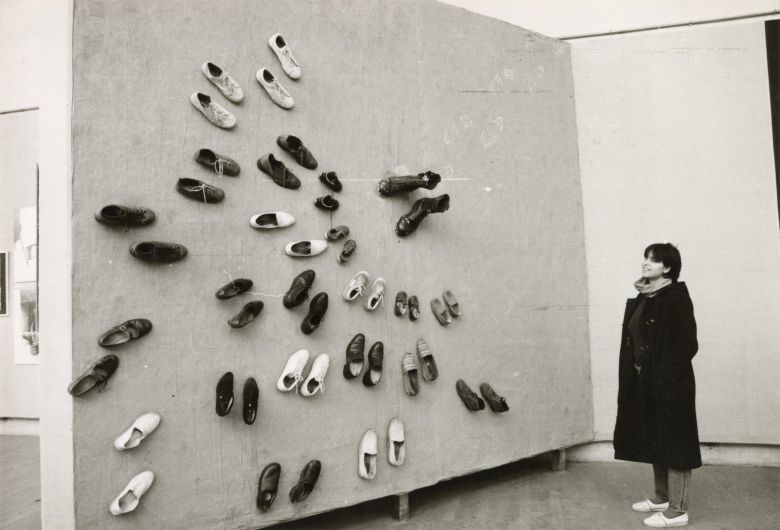
Handan Börüteçene with her work Against War, 34éme Salon de la Jeune Peinture, Grand Palais (Paris), 1983
Following In the Realm of Three Inland Seas (Salt Beyoğlu, 2023–2024)—the most comprehensive exhibition of Handan Börüteçene’s work to date—Salt Research has made the artist’s archive accessible online.
Added to the artist archives at Salt Research, the collection offers insight into Börüteçene’s artistic practice spanning more than forty years. It includes works from the artist’s student years in Istanbul and Paris during the 1980s, as well as documents, press clippings, and images related to the exhibitions she participated in Turkey and abroad.
About Handan Börüteçene
Handan Börüteçene studied ceramics at the State Academy of Fine Arts in Istanbul. Her interest in archaeology and history led her to participate in excavations beginning in 1978. After graduating in 1981, the artist moved to Paris and continued her studies in sculpture at l’École nationale supérieure des Beaux-Arts.
Establishing unexpected connections with Turkey’s cultural heritage through sculpture, installation, photography, and text, Börüteçene received a merit award for Kır/Gör [Break/See] at the fifth edition of New Trends in Art in 1985. Producing site-specific works, the artist opened Bütün Denizlerin İçinden Geç, Sessizlik ve Sırdır Ötesi [Pass Through Every Sea, Beyond Is Silence and Secrecy] (1991) at Hagia Irene and Yeryüzünün Belleği [Memory of the Earth] (1995) at the Museum of Anatolian Civilizations. In her work, presented under different titles over time—Suların Bağladığı / Suların Çözdüğü [Waters That Tie / Waters That Untie], Kendime Gömülü Kaldım [I Remained Buried Within Myself], and Morla Döndüm. Gömülü Gecemden Sabaha [I Woke Up in Purple. From the Night I Was Buried] (1999–2023)—she traced the Byzantine cultural heritage looted and taken to Venice in the 13th century through a narrative centered on Moero of Byzantium, Istanbul’s earliest known female poet. To give Moero greater visibility, the artist sewed a replica of the dress depicted in an icon of Saint Eudokia held at the Istanbul Archaeological Museums and, in place of ornamental stones, adorned it with fragments of broken ceramics evoking vanished civilizations. The dress featured in a series of “souvenir” photographs taken at Byzantine sites in both cities.
Börüteçene currently lives in Istanbul, Paris, and Kaş, continuing her practice at the intersection of archaeology, history, nature, and cultural heritage.
Salt Research Art Archive
The archival collections at Salt Research encompass over 2,000,000 unique digitized resources on art, architecture, design, city, society, and economy. Focusing on the history of art in Turkey after 1950, the Art Archive brings together visual and textual sources from museums, artist initiatives, and foundations, alongside archives compiled by artists and curators and materials related to historically significant exhibitions. To explore the collections: archives.saltresearch.org.
Salt Research Art Archive is supported by Hande Bozdoğan and Murat Çağlar.
Added to the artist archives at Salt Research, the collection offers insight into Börüteçene’s artistic practice spanning more than forty years. It includes works from the artist’s student years in Istanbul and Paris during the 1980s, as well as documents, press clippings, and images related to the exhibitions she participated in Turkey and abroad.
About Handan Börüteçene
Handan Börüteçene studied ceramics at the State Academy of Fine Arts in Istanbul. Her interest in archaeology and history led her to participate in excavations beginning in 1978. After graduating in 1981, the artist moved to Paris and continued her studies in sculpture at l’École nationale supérieure des Beaux-Arts.
Establishing unexpected connections with Turkey’s cultural heritage through sculpture, installation, photography, and text, Börüteçene received a merit award for Kır/Gör [Break/See] at the fifth edition of New Trends in Art in 1985. Producing site-specific works, the artist opened Bütün Denizlerin İçinden Geç, Sessizlik ve Sırdır Ötesi [Pass Through Every Sea, Beyond Is Silence and Secrecy] (1991) at Hagia Irene and Yeryüzünün Belleği [Memory of the Earth] (1995) at the Museum of Anatolian Civilizations. In her work, presented under different titles over time—Suların Bağladığı / Suların Çözdüğü [Waters That Tie / Waters That Untie], Kendime Gömülü Kaldım [I Remained Buried Within Myself], and Morla Döndüm. Gömülü Gecemden Sabaha [I Woke Up in Purple. From the Night I Was Buried] (1999–2023)—she traced the Byzantine cultural heritage looted and taken to Venice in the 13th century through a narrative centered on Moero of Byzantium, Istanbul’s earliest known female poet. To give Moero greater visibility, the artist sewed a replica of the dress depicted in an icon of Saint Eudokia held at the Istanbul Archaeological Museums and, in place of ornamental stones, adorned it with fragments of broken ceramics evoking vanished civilizations. The dress featured in a series of “souvenir” photographs taken at Byzantine sites in both cities.
Börüteçene currently lives in Istanbul, Paris, and Kaş, continuing her practice at the intersection of archaeology, history, nature, and cultural heritage.
Salt Research Art Archive
The archival collections at Salt Research encompass over 2,000,000 unique digitized resources on art, architecture, design, city, society, and economy. Focusing on the history of art in Turkey after 1950, the Art Archive brings together visual and textual sources from museums, artist initiatives, and foundations, alongside archives compiled by artists and curators and materials related to historically significant exhibitions. To explore the collections: archives.saltresearch.org.
Salt Research Art Archive is supported by Hande Bozdoğan and Murat Çağlar.

